
Introduction
Enzyme-Linked Immunosorbent Assays (ELISA) constitute a cornerstone of contemporary immunoassays, enabling precise quantitative and qualitative detection of antigens, antibodies, peptides, cytokines, and other biomolecules across picogram-to-nanogram concentration ranges. Developed in the early 1970s, ELISA platforms integrate antigen–antibody specificity with enzymatic signal amplification, delivering high sensitivity (often <10 pg/mL), specificity, and throughput in a microplate format. In biomedical research and biotechnology, ELISA kits facilitate cytokine profiling, biomarker validation, therapeutic protein quantification, immunogenicity assessment, and diagnostic screening. Their scalability, compatibility with automation, and compliance with regulatory standards (GMP, FDA, EMA) render them indispensable for translational studies, clinical diagnostics, and industrial bioprocessing. This review delineates the fundamental principles, optimization strategies, applications, advantages/limitations, emerging innovations, and best practices of ELISA technology.
1. Principles of ELISA Kits
ELISA exploits specific antigen–antibody interactions anchored to a solid phase (typically 96-well polystyrene microplates), with enzymatic conversion of a substrate generating a measurable signal (absorbance, fluorescence, or luminescence). Four primary formats predominate, each optimized for analyte characteristics and experimental objectives.
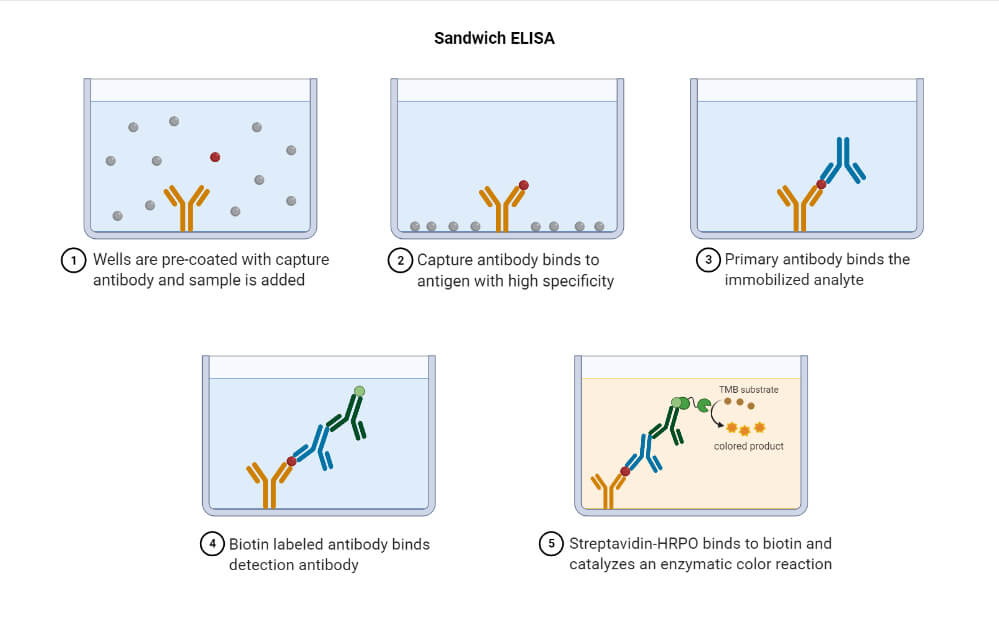
1.1 Sandwich ELISA In sandwich ELISA, a capture antibody is immobilized on the plate; the analyte is bound between capture and enzyme-conjugated (or biotinylated) detection antibodies. This dual-antibody configuration confers exceptional specificity and sensitivity by minimizing cross-reactivity.
Applications: Cytokine quantification, low-abundance biomarker detection, and monoclonal antibody validation. Typical limits of detection reach 1–10 pg/mL for cytokines such as IL-6 or TNF-α.
1.2 Competitive ELISA
The sample analyte competes with a fixed labeled antigen for limited antibody binding sites. Signal intensity is inversely proportional to analyte concentration, rendering the format ideal for small molecules or haptens.
Applications: Hormone/metabolite quantification, drug screening, and ligand-binding studies.
1.3 Indirect ELISA
Antigen is coated directly onto the plate; primary antibodies from the sample bind, followed by enzyme-linked secondary antibodies for signal amplification. This format excels in antibody titer determination.
Applications: Serological diagnostics, vaccine immunogenicity, and autoantibody screening.
1.4 Principles of Signal Detection
Common enzymes include horseradish peroxidase (HRP) and alkaline phosphatase (AP). Substrates such as TMB (for HRP) yield measurable absorbance at 450 nm post-stop solution addition. Fluorogenic or chemiluminescent substrates enhance sensitivity for low-abundance analytes. Signal is quantified via microplate readers; standard curves enable absolute quantification.

2. Optimization of ELISA Protocols
Robust performance demands systematic optimization to achieve maximal signal-to-noise ratio, reproducibility (CV <10%), and accuracy.
2.1 Antibody Selection and Validation High-affinity, validated monoclonal or polyclonal pairs (KD <10⁻⁹ M) are essential. Cross-reactivity testing against related analytes and matrix-matched validation are mandatory.
2.2 Sample Handling and Preparation Dilution in appropriate buffers, protease inhibition, and removal of interferents (hemoglobin, lipids) prevent matrix effects. Freeze–thaw cycles should be minimized.
2.3 Reaction Conditions Optimal pH (7.0–7.4), ionic strength, temperature (RT or 37 °C), and incubation times (1–2 h) are determined empirically. Buffer composition (PBS-Tween, BSA) influences kinetics.
2.4 Standardization and Calibration
Standard curves are fitted using the four-parameter logistic (4PL) model
2.5 Minimizing Background and Noise
Blocking with 1–5% BSA or non-fat milk, optimized wash volumes (3–5×300 µL), and detergent concentration (0.05% Tween-20) reduce nonspecific binding.
3. Applications in Research and Biotechnology
3.1 Biomarker Discovery and Validation
Multiplex-capable ELISA arrays profile >100 analytes simultaneously, supporting disease signature identification and companion diagnostics.
3.2 Drug and Biotherapeutic Development
Quantification of monoclonal antibodies, biosimilars, and host-cell proteins ensures process consistency and immunogenicity monitoring.
3.3 Clinical Diagnostics
Detection of viral antigens (e.g., SARS-CoV-2), tumor markers (PSA, CEA), and autoantibodies underpins high-throughput screening.
3.4 Industrial Bioprocess Monitoring
Real-time quantification of recombinant proteins in bioreactors facilitates yield optimization and impurity profiling.
4. Advantages and Limitations
4.1 Advantages Superior specificity, broad dynamic range (3–4 logs), automation compatibility, and regulatory acceptance.
4.2 Limitations Matrix interference, antibody dependency, and reduced performance for very small molecules. Mitigation via multiplex platforms, nanoparticle enhancement, and microfluidic integration addresses these constraints.
5. Emerging Trends and Technological Innovations
5.1 Multiplex ELISA Platforms Bead-based (xMAP®/Luminex) or planar arrays enable simultaneous detection of dozens of analytes, conserving sample volume and time.

5.2 Microfluidic and Lab-on-a-Chip Systems
Miniaturized channels reduce reagent consumption (>90%) and assay time (<30 min) while enhancing sensitivity through improved mass transport.

5.3 Automated ELISA Workflows
Robotic liquid handlers and integrated readers achieve >99% reproducibility and LIMS connectivity.
5.4 Signal Enhancement Technologies
Nanoparticles, chemiluminescence, and tyramide signal amplification push detection limits into femtogram ranges.
5.5 Integration with Omics and Digital Analytics
ELISA data fusion with proteomics and machine-learning models accelerates biomarker discovery and therapeutic optimization.
6. Industrial and Regulatory Applications
6.1 Biopharmaceutical Production
GMP-compliant ELISA ensures lot-release testing of biologics and vaccines.
6.2 Diagnostics Industry
Standardized kits support global clinical laboratories with minimal batch variability.
6.3 Research and Development
Quantitative immunoassays underpin preclinical efficacy and safety studies.
7. Best Practices for ELISA Implementation
- Select affinity-validated antibody pairs with documented specificity.
- Employ matrix-matched blocking, washing, and incubation protocols.
- Incorporate technical/biological replicates, spiked controls, and 4PL curve fitting.
- Leverage automation for precision and traceability.
- Conduct routine calibration and proficiency testing per CLSI guidelines.
Conclusion
ELISA kits remain a foundational technology in life sciences, bridging fundamental immunology with applied biotechnology through unmatched versatility and quantitative rigor. Strategic optimization of reagents, protocols, and instrumentation, coupled with adoption of multiplex, microfluidic, and automated platforms, maximizes sensitivity, reproducibility, and scalability. Continued integration with omics technologies and digital analytics will further expand ELISA’s role in precision medicine, biomarker-driven drug development, and industrial bioprocessing. As evidenced by extensive peer-reviewed validation, ELISA platforms will sustain their strategic importance in delivering accurate, reproducible, and impactful biomedical outcomes.